Like many couples starting their fertility journey, you and your partner must have undergone Intrauterine Insemination (IUI). IUI is less invasive than In Vitro Fertilization (IVF), more affordable, and seems like a natural first step for most couples. If you have already gone through one or more IUI cycles without success, you might be wondering whether to try IUI again or move on to IVF.
Knowing when to shift from IUI to IVF helps save precious time, reduce emotional strain, and sometimes even lower overall costs. This blog is designed to help couples make a clear and informed decision, especially those seeking fertility treatment in cities like Visakhapatnam, Kakinada, Rajahmundry, Vizianagaram, and Ankapalli.
Understanding the Difference Between IUI and IVF
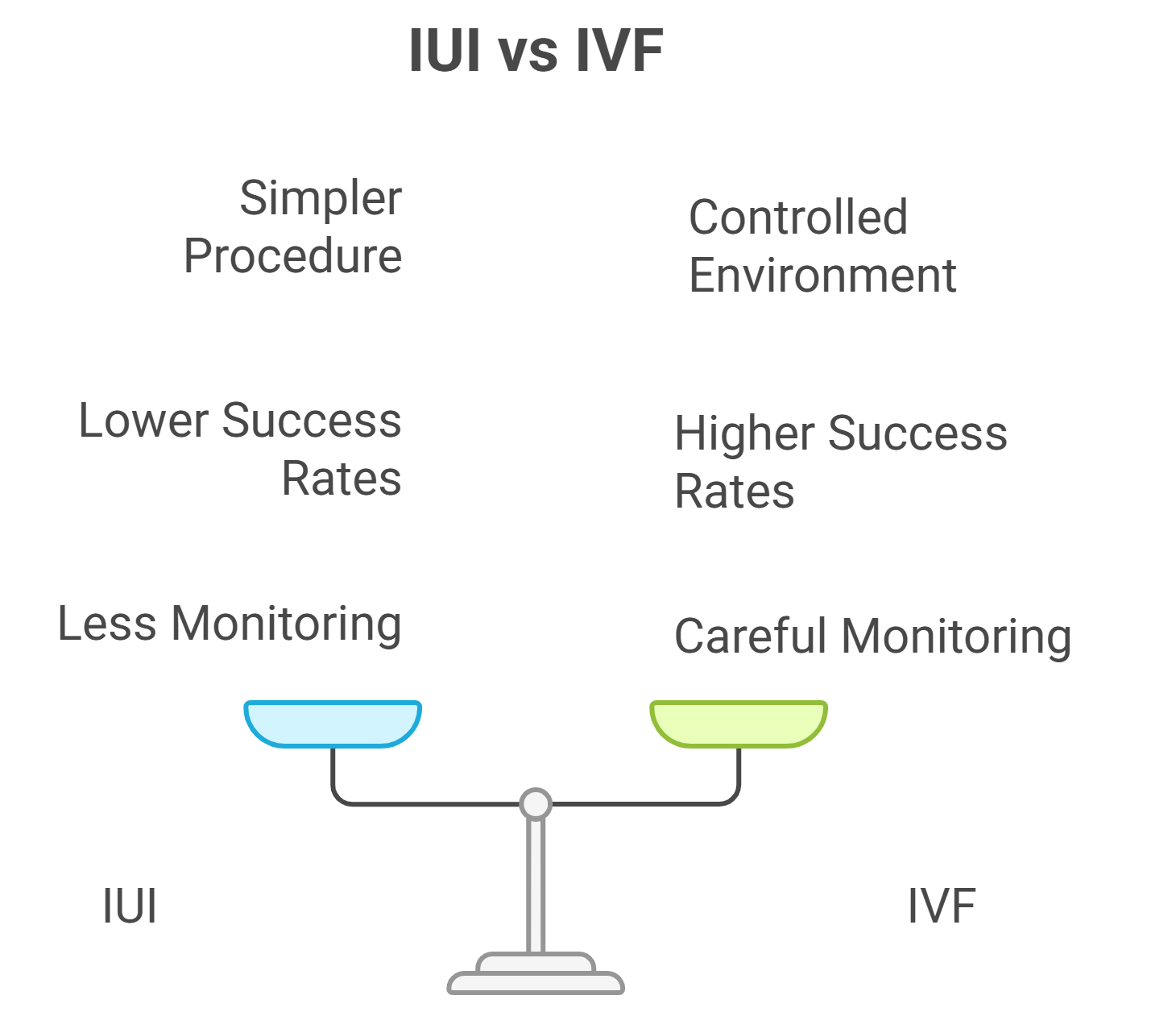
IUI involves placing prepared sperm directly into the uterus around ovulation. IUI works best if you have mild fertility challenges, regular ovulation, open fallopian tubes, and reasonably healthy sperm parameters. Read our step-by-step guide on the IUI procedure here.
IVF is a much more controlled and proactive approach. In an IVF cycle, eggs are retrieved from the ovaries and fertilized with sperm in a laboratory setting. This allows embryologists to monitor the fertilization process and select the healthiest embryos to transfer back into the uterus. IVF has higher success rates because fertilisation, embryo development, and timing are carefully monitored.
How Many IUI Cycles Are Usually Recommended
Most fertility specialists recommend three to four IUI cycles. If pregnancy does not occur within these attempts, the chances of success with further IUIs reduce significantly. Instead of repeating cycles without change, this is the stage where outcomes should be reviewed. Factors such as egg response, sperm quality, and uterine conditions need reassessment before deciding the next step.
Signs It May Be Time to Move from IUI to IVF
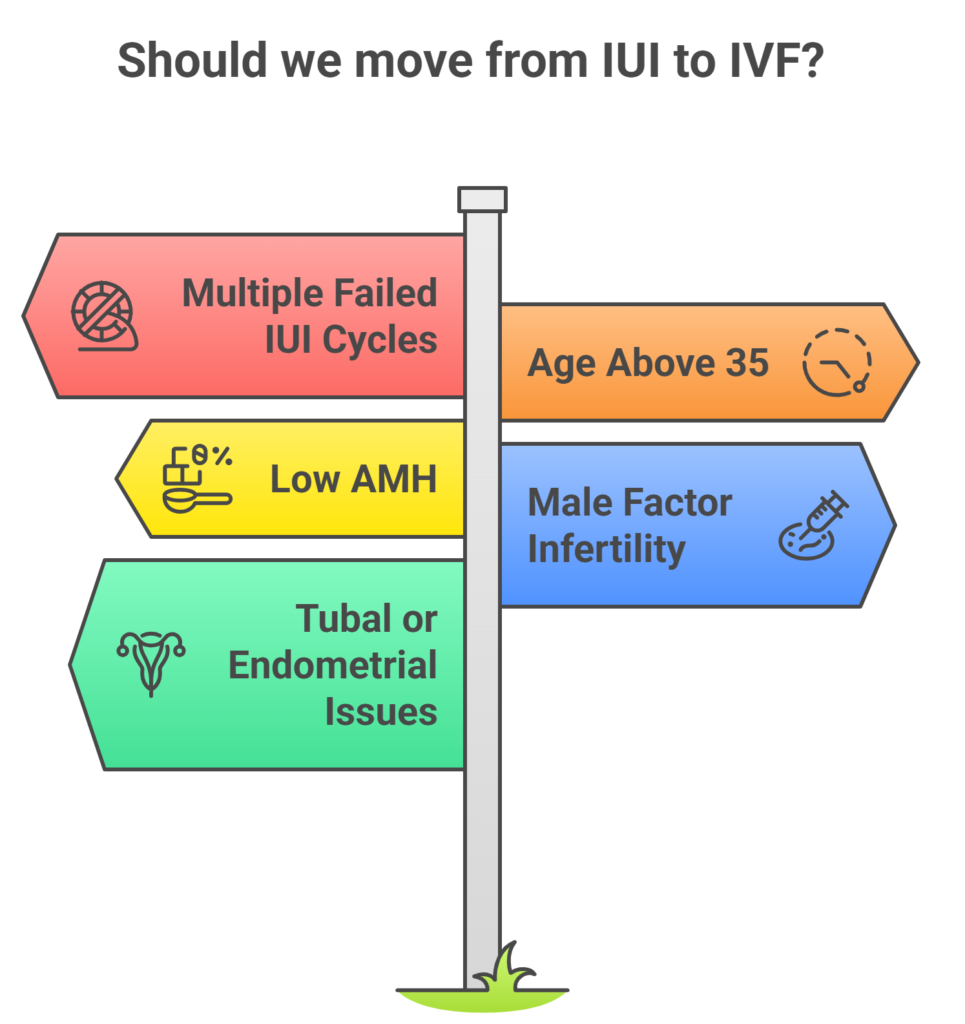
Every couple’s fertility journey is unique, but there are several clear indicators that IVF might be a more effective option for you.
Multiple Failed IUI Cycles
If you have completed three or more properly timed IUI cycles without success, undergoing more IUI cycles will usually add emotional strain without improving results. You can have underlying issues related to egg/sperm quality or even how the embryo interacts with the uterine lining.
Age Above 35
Age directly affects egg quality. After 35, fertility declines faster, making time an important factor. Because IVF has a higher success rate per attempt, many specialists recommend moving to IVF sooner to maximize the chances of success while egg quality is still optimal.
Low AMH or Reduced Ovarian Reserve
If blood tests show a low Anti-Mullerian Hormone (AMH) level, it indicates a lower egg count. In these cases, IVF is often preferred because it allows doctors to retrieve as many eggs as possible in a single cycle and potentially freeze extra embryos for the future.
Male Factor Infertility
IUI requires a certain threshold of healthy, motile sperm to be effective. If sperm counts are low or if there are significant issues with morphology, the sperm may still struggle to reach and penetrate the egg naturally. IVF, specifically with ICSI (Intracytoplasmic Sperm Injection), can solve this by injecting a single healthy sperm directly into the egg.
Tubal or Endometrial Issues
When the fallopian tubes are damaged, or when moderate to severe endometriosis is present, the natural pathway that IUI depends on does not always function as it should. In these situations, continuing with IUI may only lead to more waiting without real progress. IVF can be a more effective next step because it bypasses the fallopian tubes completely and allows treatment to move forward in a more controlled way.
Emotional and Financial Considerations
When you are faced with multiple failed IUI cycles, it can lead to emotional fatigue. The uncertainty of waiting every month to know whether you are pregnant or not can be more draining than the treatment itself.
Financially, while IUI is cheaper per cycle, the costs can add up quickly. In some situations, moving to IVF earlier can be more cost effective and emotionally sustainable in the long run. Read our blog to learn more about IVF costs in Vizag.
Why Timing Matters More Than Trying One More IUI
It is common to want to try “just one more IUI” because it feels easier. If you spend a year or two on IUI without success, your age or ovarian reserve may change in that time, potentially making IVF less effective than it would have been if you started sooner. Fertility treatment tends to work best when there is a clear plan in place, rather than repeating the same steps without stopping to reassess what is actually working. Studies have shown that IVF often results in about twice as many clinical pregnancies per cycle compared to IUI. Moving to IVF at the right time can improve outcomes and also reduce the emotional strain that comes with months of uncertainty.
Do not view moving from IUI to IVF as a failure. It is a positive step forward when guided by the right medical advice. By making an informed and timely decision, you are taking charge of your journey and putting yourself in the best possible position to grow your family.
Couples across Visakhapatnam, Kakinada, Rajahmundry, Vizianagaram, and Anakapalli can seek personalised guidance at London IVF Centre, where experienced specialists focus on timely decisions, transparent counselling, and compassionate fertility care.